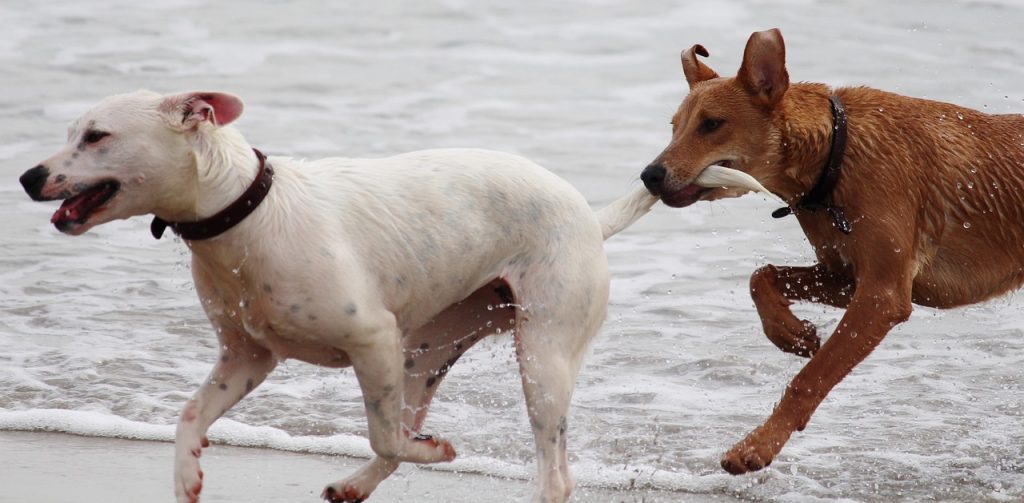
Whether they’re short and stubby, long and fluffy, or even end in a pom-pom, all dogs have tails. And chances are, if you own a dog, you see it wagging all the time! Despite how important tails are to the day-to-day life of our best friends, most people don’t actually know all about their pups’ tails.
What is a dog’s tail made of?
A dog’s tail is an extension of its spine that extends past the sacrum. Tails are made up of 5-20 bones connected to one another by cartilage and covered with muscle, nerves, and tendons to allow them to move, as well as blood vessels to supply these tissues with oxygen.
We’ll go over the basic anatomy of a dog’s tail as well as address common questions about tails and tail injuries.
What Is A Dog’s Tail Made Of?
It may be tempting to say a dog’s tail is just the part of it that wags and leave it at that, but the true answer is a bit more complex. To understand exactly what a dog’s tail is, it’s important to understand some basic doggy anatomy. You don’t need to be an expert to understand the basic bone structure of a dog’s spine, and it can help explain what its tail is made of.
Basic Dog Backbone Anatomy
In humans and dogs alike, the backbone is made of several connected bones known as vertebrae and extends the length of the body. These bones are connected to one another with cartilage and ligaments. A dense bundle of nerves known as the spinal cord runs through the middle of each vertebrae and carries information from the brain throughout the body to help it move.
Dogs have 26 vertebrae that run from their neck to the sacrum. The sacrum is the large bone that connects to the hips and leg bones. In dogs, it is actually formed from three fused vertebrae.
For humans, there’s a single tiny bone after the sacrum known as the coccyx. If you’ve ever fallen flat on your bum and bruised your “tailbone,” you know exactly what it is! For dogs, on the other hand, their spine continues on to form the tail.
Do Dogs Have Bones in Their Tails?
In short, yes! Dogs have several bones in their tails.
Any bones after a dog’s sacrum are known as caudal bones or tail bones. A dog can have anywhere from 6 to 23 of these bones depending on the length of its tail, with an average of 20.
Tail bones start wide at the base and gradually taper off into the tip of the tail. As with the rest of the spine, they are attached to one another by several types of cartilage and ligaments and enclose the fragile spinal cord.
Between each vertebra is a gelatinous intervertebral disk that acts as a joint, cushion, and hinge between each tailbone. This is why your dog’s tail can wiggle around as it does!
Do Dogs Have Muscles in Their Tails?
In addition to nerves and vertebrae, a dog’s tail is mostly made up of muscle.
Muscles known as caudal muscles attach to tail bones with tendons. 4 to 7 paired nerves are used by dogs to send signals from their brains to their caudal muscles. This allows them to coordinate movement in their tails for a variety of reasons, such as balance and making turns while swimming.
Even for dogs with docked tails, such as Rottweilers or working Boxers, tail movement is a major aspect of dog body language. Your dog’s nub will still wag, drop, curl and participate in the famous play bow to the best of its ability.
Do Dogs Have Feeling in Their Tails?
Those of us who have accidentally stepped on our pup’s tails have seen firsthand how sensitive they are. That yelp and jump aren’t just for show– it really does hurt!
The nerves that run through a dog’s tail are not only for movement but for feeling. A dog’s tail has receptors for touch, pain, and heat just like most other parts of their body.
Can Dogs Break Their Tails?
A dog’s tail may be very flexible, but the small bones inside it are able to be fractured like any other bone. There are many reasons a dog’s tail can be broken, such as being run over by a vehicle, slammed into a door, or even landed on in a fall.
A fracture of any sort is painful to your dog, including one or more of the tiny bones in its tail. It’s important to be able to identify any sorts of sprains or fractures in your dog, as these are both painful and can result in permanent damage.
How To Know If A Dog’s Tail is Injured
A dog’s tail is surprisingly fragile, and it’s common for dogs to get tail injuries. While many of these injuries are easy to see, such as visible scratches and bald spots caused by cuts and wear, some are harder to spot.
Signs a Dog’s Tail is Sprained
It’s hard to imagine dogs not wagging their tails, but limp tails are common in the canine world. Commonly known as limber tail, swimmer’s tail, dead tail, and a variety of other names, a sprained or strained tail occurs whenever a dog overexerts their tail muscles. As the name implies, the main symptom of a dog with limber tail is a noticeably limp tail, which may be completely limp from base to end or be partially limp.
Along with this limpness, dogs with limber tail will often whine, be lethargic, lick and chew at their tail, or otherwise express pain and discomfort. Typically, limber tail occurs whenever a dog overexerts their tail muscles while exercising or swimming, but prolonged time in an inappropriately sized crate and even exposure to cold weather are possible causes.
Although the typical treatment for limber tail is simply resting, it’s still a good idea to see a vet to rule out fractures or any other issues, as many tail injuries have overlapping symptoms.
Signs a Dog’s Tail is Broken
Unlike limber tail, the cause of a broken tail is usually pretty dramatic. Your dog may take a strange fall, get their tail caught in a door, or even get their tail ran over. Chances are, this unfortunate event is accompanied by a loud yelp, and I don’t have to tell you that a vet visit is in order.
A particularly bad break can be easily spotted, with an obvious kink in the tail. That said, small fractures at the end of the tail are also possible, and a fracture shouldn’t be ruled out simply because it is not obvious. More subtle signs of pain and swelling are still worth veterinary investigation, as tail fractures may require intensive treatment, such as resetting or even amputation.
Signs a Dog’s Tail Has Nerve Damage
There are many reasons to tell your children not to pull on puppy dog tails, and arguably the most important reason is that tail pulling– also known as avulsion– can cause permanent nerve damage in dogs. While avulsion is one of the most common causes, some dogs also experience degenerative nerve diseases.
Occasionally, nerve damage at the base of your dog’s tail can cause incontinence, and the inability of your dog to raise their tail while defecating can lead to some nasty skin infections.
Unfortunately, nerve damage is permanent in most cases, but some treatment options are available. Potential nerve damage should always be assessed by a veterinarian.
What To Do If Your Dog’s Tail is Injured
Simple, uncomplicated injuries such as surface bumps or cuts can often be managed with simple first aid, such as antibiotics and bandages. Anything other than a small cut or any more complicated injuries should always be evaluated by a vet for proper diagnosis and treatment. This may include oral antibiotics, pain medication, or a variety of other treatments.
Closing Thoughts
A dog’s tail is an important tool for balance, locomotion, and of course, basic communication. A dog’s tail tail is full of bones, muscles, nerves, and blood vessels that enable it to make a variety of fine movements. It’s a good idea for owners to understand their dog’s basic tail anatomy and keep an eye out for any potential injuries. After all, seeing a wagging tail is one of the best sights in the world!










Рік 2025 у світі тварин — важливі відкриття та поради.
⚠️ We suggest that you read all the opinions on our portal and take note of them at your own discretion. Do not self-medicate! In our articles we collect the latest scientific data and opinions of authoritative experts in the field of health care. But remember: only a doctor can diagnose and treat.
The portal is intended for users over 13 years old. Some materials may not be suitable for children under the age of 16. We do not collect personal data from children under 13 without parental consent.We have a small request. We strive to create quality content about pet care, and we make it available for free to everyone because we believe everyone deserves accurate and useful information.
Advertising revenue only covers a small portion of our costs, and we want to continue to provide content without having to increase advertising. If you have found our content useful, please support us. It only takes a minute, but your support will help us reduce our reliance on advertising and create even more useful articles. Thank you!